
The Gulf Coast LNG Corridor Is Being Assembled by Acquisition. That Makes It a Records Problem.
.jpg)


The Gulf Coast LNG Corridor Is Being Assembled by Acquisition. What Comes With the Pipe Is Worth Thinking About.
On August 3, Williams announced an agreement to acquire Momentum Midstream for up to $5.5 billion, roughly $3.5 billion in cash and debt plus about $2 billion in equity. The strategic logic is one the sector has been repeating for two years: get Haynesville gas to the Gulf Coast, where LNG export and power demand is going. Williams put a number on that demand in its own release, projecting Gulf Coast LNG demand to grow by approximately 20 Bcf/d over the next ten years.
Alongside the deal, Williams sanctioned two expansions. Delta Access, a $1.5 billion project along the Transco corridor, will provide 2.25 Bcf/d of initial capacity with service targeted for the first quarter of 2029. The Shelby Trough Connector, a 64-mile expansion of the Louisiana Energy Gateway system, adds 750 MMcf/d initially with expansion potential to 1.5 Bcf/d, targeted for the second quarter of 2028. Within days, Venture Global confirmed that its planned Plaquemines expansion would take feedgas from Delta Access, giving the project an export anchor on its east end.
That's the strategic story, and it's a clean one. We have no visibility into how Williams or Momentum keep their records, and we're not going to speculate about it. But the shape of this transaction is one a lot of land and operations teams will recognize, and it's worth talking through what that shape tends to bring with it.
What Can Come With 4,000 Miles of Pipe
Momentum's platform brings more than 4,000 miles of pipeline, over one million dedicated acres across four gathering areas, multiple treating and processing facilities, and three take-or-pay pipelines. Those are the numbers in the announcement, and they're the numbers a market models against.
The numbers that don't appear in any announcement are the ones land and operations teams inherit on closing day. If you've been through an acquisition of this size, you may recognize the list:
- Every easement and right-of-way agreement across the acquired acreage, each with its own width, term, consideration structure, restoration obligations, and renewal conditions.
- Every road, rail, waterway, and foreign-line crossing permit, with its own expiration and its own counterparty.
- Every encroachment file, damage claim, and landowner commitment, some of it documented and some of it made verbally in the field by an agent who may no longer be there.
- Every as-built, alignment sheet, and depth-of-cover survey, in whatever coordinate system and file format the acquired company happened to use.
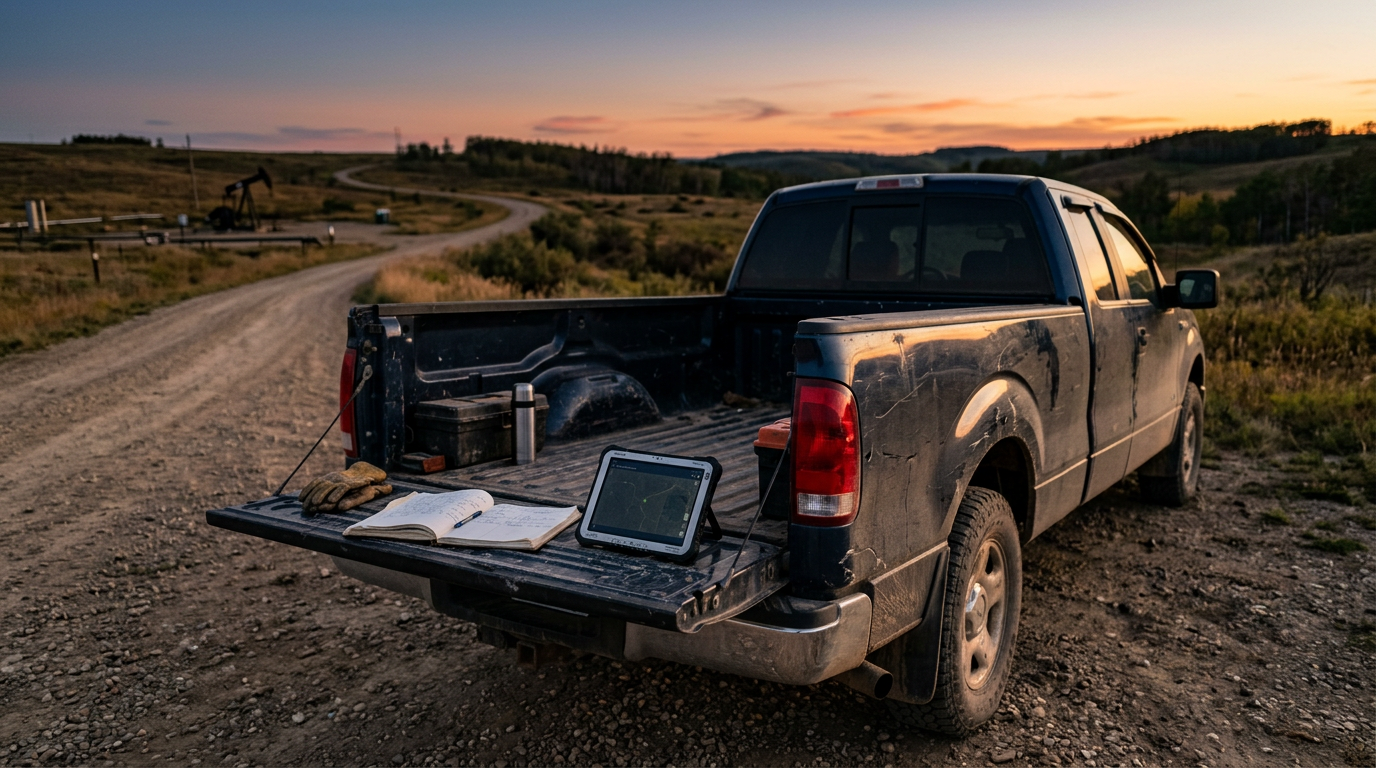
In our experience, none of that arrives in a queryable state on its own. It tends to arrive as file shares, scanned PDFs, spreadsheets maintained by one person, and a GIS instance built on assumptions nobody wrote down. Sometimes the acquired records are in better condition than anyone expected. Sometimes verifying that, tract by tract, turns into a multi-year job that starts the day the deal closes. Which one you're facing usually isn't clear until someone goes looking.
Where the Schedule Can Make It Urgent
In a lot of integrations, a company would take eighteen quieter months to reconcile records before anything else demanded attention. Concurrent construction can close that window.
Shelby Trough Connector is targeted for second-quarter 2028 service. Delta Access is targeted for first-quarter 2029. Both are being built across and adjacent to the footprint being acquired. When that happens, integration of the legacy land record and greenfield right-of-way acquisition for new construction run at the same time, often through the same land teams, sometimes on overlapping ground.
When a new lateral crosses a tract already burdened by an acquired easement, someone has to answer a specific question: what did the previous operator already agree to here, and does it constrain what we can offer now? If that answer comes back in an afternoon, there's no story. If it takes three weeks to assemble from four systems, it can show up as schedule variance, and on a project with a contracted in-service date tied to a terminal's feedgas need, schedule variance tends to compound.
What a Finished Integration Tends to Look Like
We won't tell you how to run your integration. But across the ones we've supported, the ones that closed out rather than quietly staying open tended to share three things:
One system of record rather than a federation of them. Acquired and organic assets on the same data layer, in the same coordinate system, with the same field definitions. Short of that, the reconciliation problem doesn't get solved so much as handed to whoever asks the next question.
Provenance at the document level. Every obligation traceable to the instrument that created it. When a landowner disputes a restoration term four years out, the defensible answer is the recorded agreement, not a spreadsheet entry someone typed from it.
A path through the document backlog that isn't manual re-keying. This is where volume tends to defeat the plan. Tens of thousands of agreements in inconsistent formats, holding terms nobody has extracted. Reading them one at a time is a budget line that's hard to close.
Where Our Work Fits
That last part is what we build for.
Arpium puts acquired and organic assets on one GIS foundation, so a question about a tract returns one answer regardless of which company originally acquired it. Skyray carries right-of-way acquisition on that same layer, which is what keeps a concurrent integration and a new-build program from running as two disconnected efforts.
The document backlog is the piece we're still building for. Steel Nexus, our AI layer, is in development and not yet released. It's being built to read easements, crossing agreements, and field reports and surface the terms buried in them, rather than waiting for someone to key them in. If that's the part of the problem you're sizing up, we're happy to talk about where it stands and what it will and won't do at launch.
The consolidation trend doesn't look like it's slowing. Upstream operators are buying midstream and export infrastructure, midstream operators are contracting end-user demand, and each of those deals hands a land team a set of records built by someone else.
If your team is integrating an acquired system while building new lines across the same footprint, that's the work Arpium and Skyray were built around, and we'd be glad to walk you through how the record comes together. If you're somewhere earlier than that and just want to ask questions, that's a conversation we're happy to have too.
Sources
- Williams Companies, "Williams Delivers Strong Second-Quarter 2026 Results; Announces Strategic Acquisition of Momentum Midstream," August 3, 2026
- Oil & Gas Journal, "Williams signs $5.5-billion deal to expand Haynesville natural gas infrastructure operations," August 5, 2026
- Natural Gas Intelligence, "Plaquemines Expansion to Anchor East End of Williams' Delta Access," August 12, 2026
- Williams Companies Q2 2026 earnings call transcript, August 2026
- PwC, "US Deals 2026 midyear outlook: Energy," June 2026