

The AI Backlash Is a Fair Verdict. Here's the KPI We Build Toward Instead.


The AI Backlash Is a Fair Verdict. Here Are the KPIs We Build Toward Instead.
There's a shift happening in how people talk about AI, and it's worth paying attention to even if you're nowhere near the consumer internet. A growing number of platforms and apps have rolled out tools and policies to flag, label, and outright ban AI-generated content. Not because the technology stopped improving. Because people got tired of being handed output that looked finished and wasn't.
The workplace version has a name now. Researchers from BetterUp Labs and Stanford's Social Media Lab called it "workslop": AI-generated content that looks like good work but lacks the substance to actually move a task forward. In a survey of 1,150 U.S. full-time workers, 41% said they'd received it in the previous month, and each instance took an average of one hour and 56 minutes to sort out. That works out to roughly $186 per worker per month, or more than $9 million a year in a 10,000-person organization. Separately, an MIT Media Lab report found that 95% of organizations saw no measurable return on their AI investments.
The most telling finding wasn't financial. Half of respondents said they viewed colleagues who sent them AI-generated work as less capable and less reliable.
We build AI features. We think that verdict is fair, and we think it points at what we should be building toward instead.
Two People Who Have Reason to Be Skeptical
In pipeline and linear infrastructure work, there are two very different people being sold AI right now. Neither of them owes the pitch the benefit of the doubt.
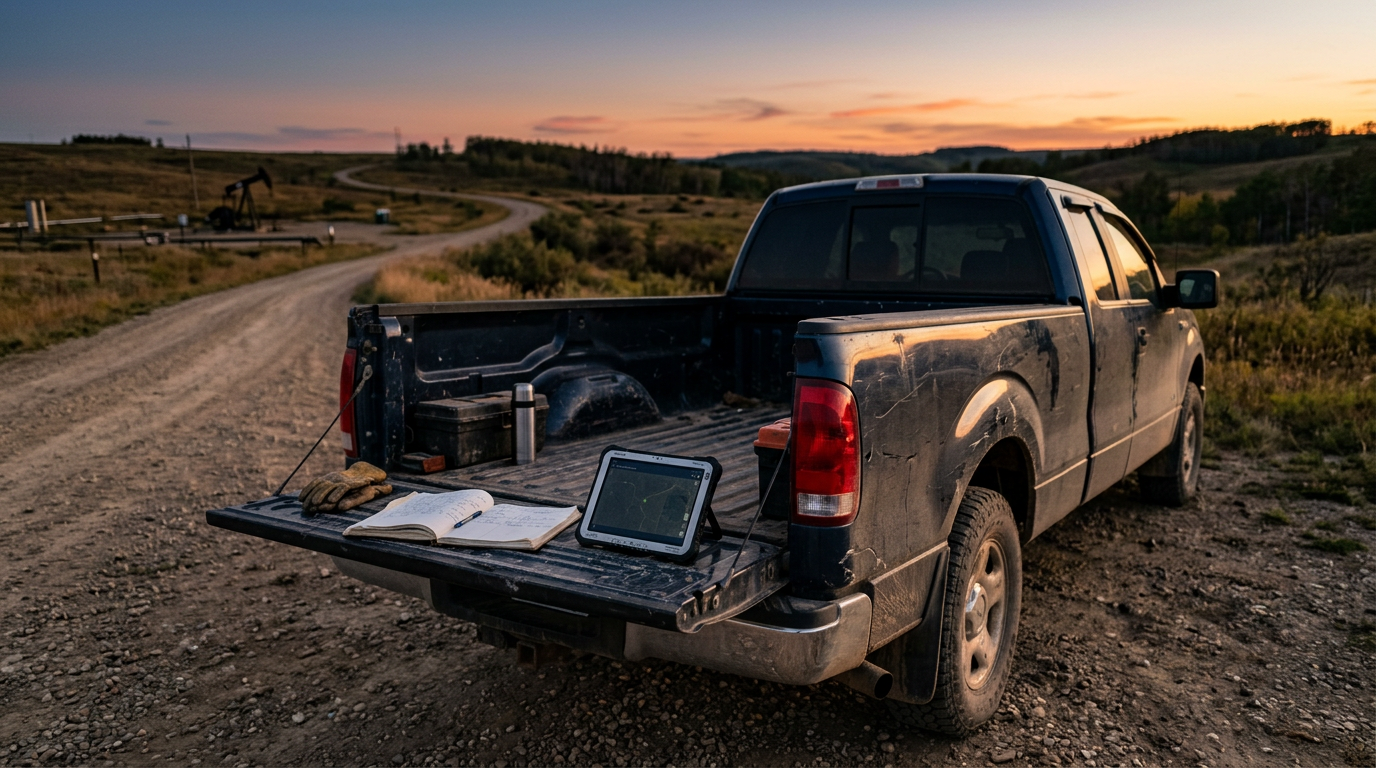
The first works outside. An inspector, a foreman, a ROW agent, a crew lead. Depending on where they've worked, they may have been handed a new app every eighteen months for a decade, each one promising to simplify the day and each one adding a form. They may have been told a system would save them time and then watched it become the thing they stayed late to feed. If that's been the pattern, then when somebody shows up talking about AI, what they're likely to hear is: another screen, and probably another reason for the office to second-guess what I saw with my own eyes.
That's not being difficult. That's being empirical.
The second works in a conference room. A VP of land, a project director, an operations lead. This is the person with more data available than anyone in this industry has ever had, and the open question is how much of it they can act on without checking it first. Some teams have that solved. A lot of the ones we talk to describe some version of the same week: four systems, three contractors' reporting formats, and a status meeting where a meaningful share of the time goes to reconciling whose number is right before anyone gets to what to do about it. Some of them are assembling on evenings and weekends the picture their systems were supposed to hand them.
Offer that person an AI summary and their first question is the correct one: where did this come from, and can I defend it if it's wrong? In right-of-way and construction records, a confident wrong answer isn't an inconvenience. It's a landowner dispute, a regulatory finding, or a claim.
Why "AI-Powered" Is the Wrong Thing to Promise a System of Record
A lot of what gets marketed as AI in enterprise software is generative. It produces something new that reads well. Our view is that this is the wrong shape for a system of record, where the value of a document is that it hasn't changed and the value of an answer is that it traces to a source.
What we've chosen to build toward is duller and, we'd argue, more useful: extraction rather than generation. Reading twenty thousand easements and pulling out the terms buried in them. Finding the crossing agreement that expires next quarter. Matching a field report to the tract it happened on. Surfacing the commitment an agent made three years ago that never made it into the master file.
Boring, verifiable, sourced. Every answer pointing back to the instrument that produced it, so the person reading it can check the work in ten seconds instead of trusting on faith. That's the standard we hold ourselves to. Short of it, what you get is automated production of things somebody else has to double-check, which is the workslop problem rebuilt inside a land department.
The KPIs We Build Toward
Efficiency in this industry usually gets expressed as cost per mile or days ahead of schedule. Those matter, and they're the ones that end up in a board deck. But they sit downstream of some more basic things, and we've found it more honest to measure the basic things directly:
Hours returned per person per week. Not "productivity." Hours. How many did this person spend last week assembling information a system should have handed them, and how many of those did we give back?
Number of systems touched to answer one question. If that count hasn't moved, we haven't done much, regardless of what a dashboard says.
Time from field observation to a decision-ready record. How long between a crew seeing something and a decision-maker being able to act on it, without a phone call in between.
Rework rate. How often a report, a status, or a data pull has to be redone because it was wrong or incomplete the first time. This is the most direct read on whether a tool is producing work or producing slop.
Share of a status meeting spent reconciling rather than deciding. If you run one of those meetings, you probably have a rough sense of the number already.
Reports finished during working hours. The simplest one, and the one people tend to feel first.
What Giving Time Back Is Actually For
Here's the part that doesn't fit neatly in a metrics table, and it's the reason we build the way we do.
Some of the most valuable work in right-of-way acquisition happens at a kitchen table. An agent sitting across from a landowner who is skeptical, or angry, or just wants to be treated like a person about something crossing land their family has held for four generations. That conversation can't be automated and shouldn't be. It's the job. An hour spent re-keying tract data into a second system is an hour not spent on the part of the work that determines whether the project moves.
The same logic holds in the office. A project director who isn't spending Thursday night reconciling contractor reports has Thursday afternoon for the one crossing that's about to become a problem. Or, and we mean this sincerely, for a soccer practice. A lot of this industry runs on people who give up evenings to make schedules hold. We'd rather software reduced that cost than converted it into a new kind of screen time.
How We Build It
Arpium and Skyray come first, and the order matters. AI applied to a fragmented, inconsistent data foundation produces confident nonsense faster than a person could produce it slowly. One spatial record, one set of definitions, one place a question gets answered, that's the prerequisite, and in the work we've done, most of the time saved comes from there rather than from anything labeled AI.
Havoc handles the field side, which is mostly capture-once discipline: what a crew records in the field becomes the record, rather than the raw material for someone else's re-entry work that night.
Steel Nexus is the layer on top, and it isn't released yet. It's in development and deliberately narrow in scope. It's being built to read the documents this industry runs on - easements, crossing agreements, daily reports, correspondence - and surface what's in them with the source attached. It won't write your status update. The goal is that it finds the four things you would have missed and shows you where they came from. We'd rather describe it that way now and let you judge it against that description at launch.
The backlash against AI slop is going to keep building, and we think it should. The companies that come out of it well probably won't be the ones with the most AI features. They'll be the ones who can point to a specific person, doing a specific job, who got their Thursday evening back.
If you can name the report someone on your team stays late to build every week, we'd like to hear about it. That's usually the most useful place to start a conversation, and it's a conversation we're glad to have whether or not you're anywhere near evaluating software. If you'd rather see it, we'll walk you through what the record looks like when it's doing that work.
Sources
- WIRED, "The AI Slop Backlash Is Actually Having an Impact," August 2026
- Harvard Business Review, "AI-Generated 'Workslop' Is Destroying Productivity," Niederhoffer, Rosen Kellerman, Lee, Liebscher, Rapuano & Hancock, September 2025
- Axios, "AI 'workslop' sabotages productivity, study finds," September 24, 2025
- MIT Media Lab, report on enterprise generative AI return on investment, 2025
- Harvard Business Review IdeaCast, "The Hidden Causes of AI Workslop and How to Fix Them," March 2026

.jpg)