
Inside the Permian-to-Gulf Coast Buildout: Why Project Management Can't Run on Spreadsheets at This Scale


Inside the Permian-to-Gulf Coast Buildout: Why Project Management Can't Run on Spreadsheets at This Scale
Permian Basin natural gas production has doubled since 2018 to roughly 25.4 billion cubic feet per day, according to EIA data - and takeaway capacity hasn't kept pace. 2026 is on track to be the largest single-year expansion of U.S. natural gas pipeline transmission capacity since 2008, with an estimated 18 to 22 billion cubic feet per day of new capacity coming online across roughly a dozen major projects in Texas, Louisiana, and Oklahoma. At least 11 new-build or expansion pipeline projects are completed, under construction, or in advanced planning at once.
The Scale of What's Underway
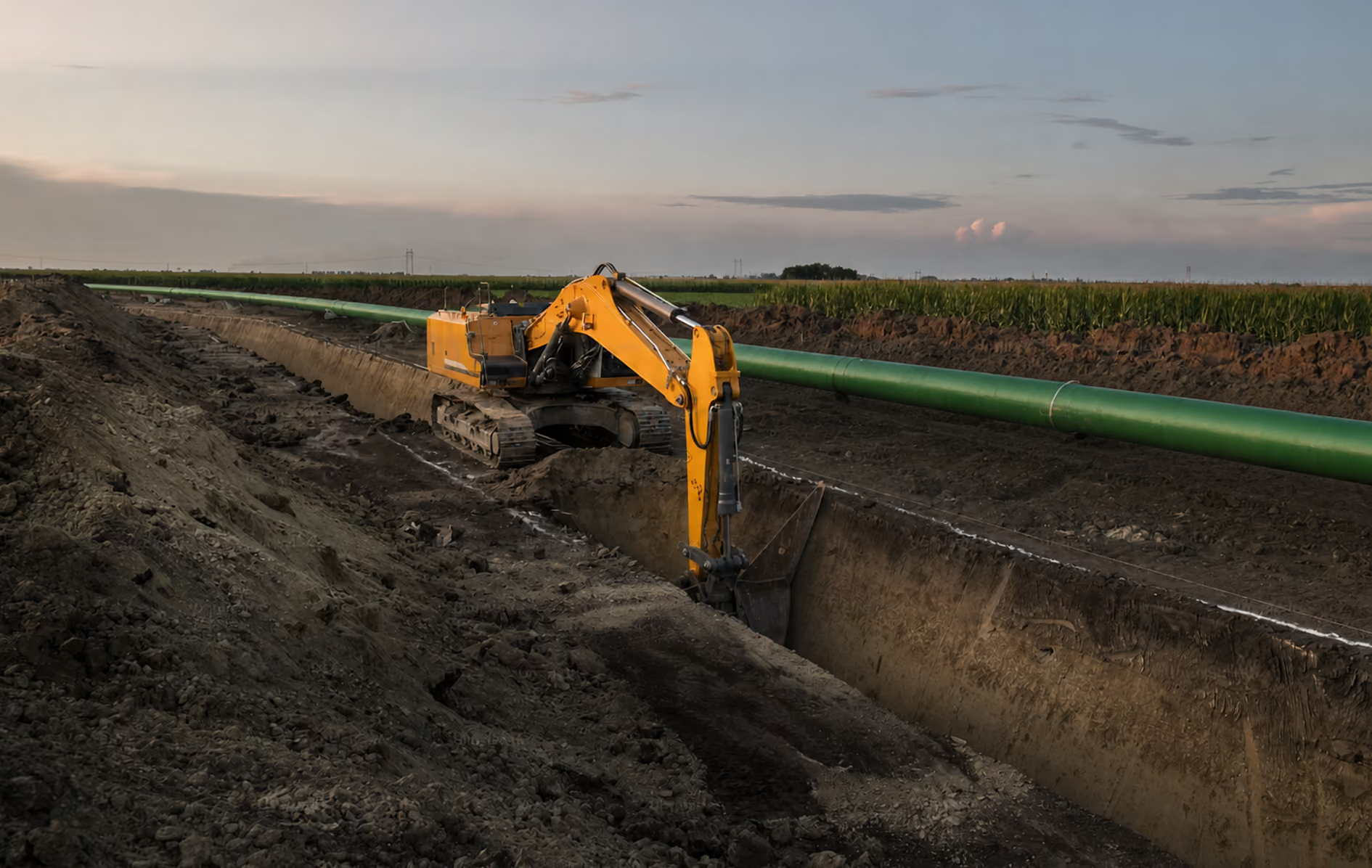
A few examples give a sense of the scale. WhiteWater Midstream's Blackcomb Pipeline spans 366 miles from multiple Permian upstream points to the Agua Dulce Hub on the Texas Gulf Coast - a 42-inch line carrying 2.5 billion cubic feet per day, expected to finish construction by late 2026. Kinder Morgan's Gulf Coast Express expansion is adding roughly 570 million cubic feet per day of capacity through new compressor stations. The Eiger Express project is designed to move approximately 3.7 billion cubic feet per day into the Katy hub, and the Louisiana Energy Gateway project adds about 1.8 billion cubic feet per day, strengthening flows from the Haynesville Basin toward Gulf Coast LNG feedgas demand.
Much of this gas is NGL-rich Permian production, which means processing, fractionation, and NGL pipeline capacity all have to scale alongside the raw gas takeaway lines - not as an afterthought, but as a parallel buildout running on the same timeline.
What Concurrent Megaprojects Actually Strain
This isn't a one-time surge. The Interstate Natural Gas Association of America estimates North America will need more than $1 trillion in new midstream investment through 2042, including at least 37,000 miles of new natural gas transmission pipelines and roughly 103,000 miles of new gathering lines. That's a multi-decade program, not a single capital cycle - which means the operational systems built to manage today's projects need to hold up across years of sustained, overlapping construction.
The risk in an environment like this usually isn't any single project failing outright. It's losing visibility across a portfolio of them running at the same time - different contractors, different regulatory dockets, different timelines, all competing for the same internal attention.
Visibility as the Real Constraint
Capital is available, and the engineering talent to design these projects exists. What's harder to scale is the operational visibility to know, in real time, the true status of every active project, every contractor, and every milestone - without waiting for a weekly rollup that's already a week stale by the time it's read.
That's the gap Arpium is built to close: a common operating picture that ties project data together across multiple simultaneous builds, so the constraint on growth is never "we didn't know where things stood."
Sources:
- Infrastructure Capital Advisors (Substack), "The Permian Pipeline Buildout Reaches Critical Mass" (May 11, 2026)
- Energy In Depth, "Pipeline Buildout Back in Focus as Energy Demand Accelerates" (May 12, 2026)
- BIC Magazine, "U.S. natural gas pipeline capacity hits largest single-year expansion since 2008" (May 1, 2026)
- RBN Energy, "Key to the Highway – Pipeline Buildout Set to Unlock Permian Natural Gas Production Growth Later in 2026" (Feb. 20, 2026)
- Interstate Natural Gas Association of America (INGAA), infrastructure investment estimate, as cited by Energy In Depth